LINKLAB Newsletter #008
“What I create becomes its own reality.”
use this space to highlight a collaborator or community member whose practice we value. These features are an opportunity to stay close to ways of thinking that resonate with our sensibilities, while extending beyond them.
This issue is dedicated to Nelson Suarez, whose artworks are a pure exploration of the omnipresent and liminal space hidden in our world.
—Sooyoun and William, Co-Founders & Principals
INSIDE
COMMUNITY: Nelson Suarez
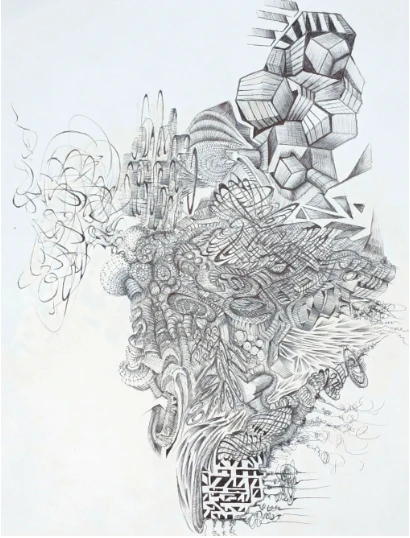
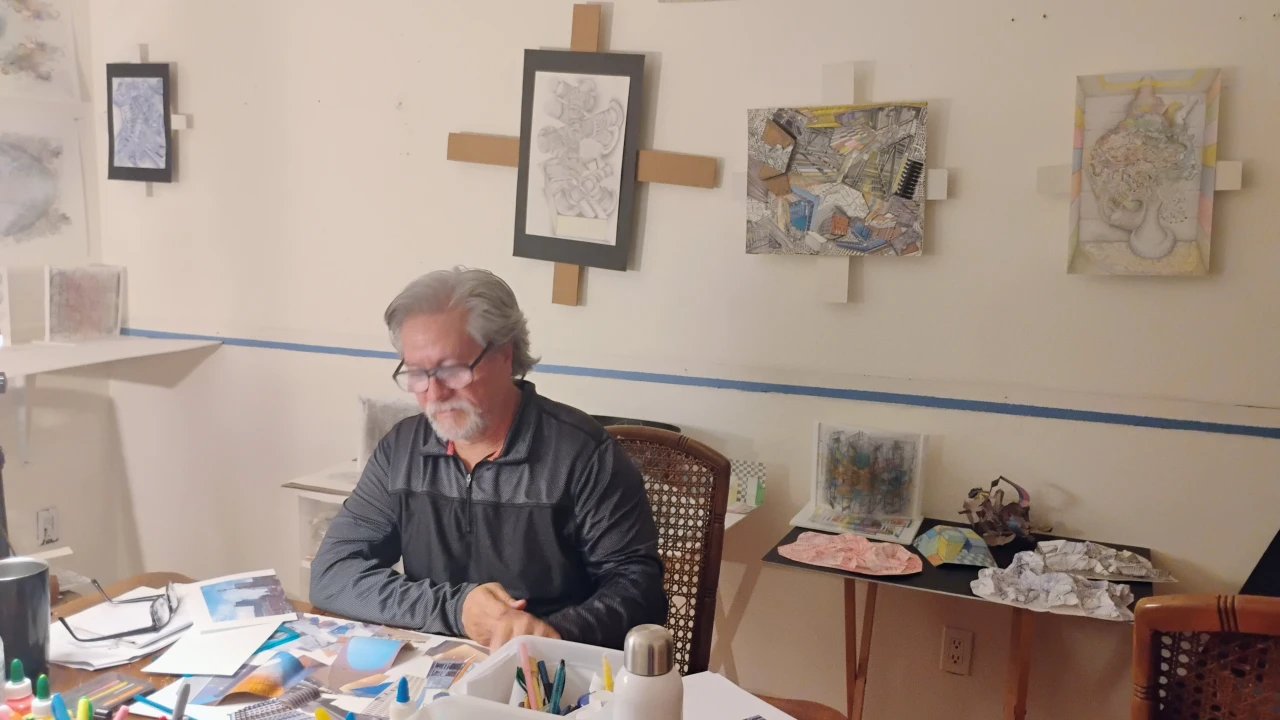
Nelson’s work begins with a simple premise: space is not fixed; it is constructed. Through a self-defined system he calls ARTITOY, drawing becomes both structure and instrument—something to be engaged, rotated, and re-seen. What emerges is a shifting field of lines, grids, and configurations that resist a single reading. In this conversation, Nelson moves between philosophy, perception, and play, outlining a practice that treats space as something to be continuously reimagined.


What is art in your mind?
I think that art is more an act of creation than an act of expression. We naturally tend to attribute to art an essential creative quality rather than an expressive one. When we react to a piece of art, we instinctively comment on how creative it is instead of how expressive. When we are surrounded by artists, we say we are with creatives instead of with expressives. We express ourselves in various ways, including art, no doubt about that; however, art itself is not characterized by expression, but by its inventive nature, the novelty of it, and the horizons it opens to human curiosity. Art is manifested by a harmless yet radical artifice or artifact. It is something artificial, something that has not existed before, a made-up alternative to what is given by nature. Therefore, art is rooted in culture rather than in nature, but at the same time, culture—everything produced by humans—is the natural way of being human. By the same token, I believe we all are artistically driven, but only a group decides for one reason or another to take the path of creation and become creatives confronting their creations, micro-gods in their own right.
How does the concept of your work come into your mind?
Since I was a child, I have been daydreaming with distant, invisible worlds, structures, and mazes, and all sorts of entities. At one point, I had the epiphany that if I never had a mirror, I would never be able to see my own face, instilling in me the urge to see the invisible of me and so much more. I thought that if I were able to step out of myself, I would succeed in my intent. The ARTITOY has been a way to attempt such an unreachable endeavor. Later in life, after wondering and pondering about this epiphany, I concluded that what I am truly doing now with the ARTITOY is exploring SPACE itself as REALITY, while fully aware that this exploration is shaped by my own quixotic, chimerical vision of it.

What exactly is an ARTITOY, and why did you feel the need to invent a new term?
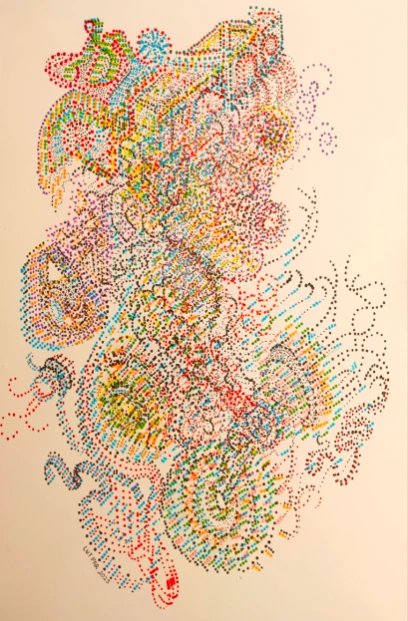
Every time I think about what an ARTITOY is, it becomes a myriad of things—ideations, elastic architectures, qualitative math, metaphysical objects, linearities, complexities, creative algorithms, daydreaming drawings, drawing‑designs, poetic visions, and more. When I stop trying to define it, the ARTITOY becomes a perceptual toy I created for myself: a set of drawn structures that let me play visual games and reclaim, in adulthood, the innocent, exploratory, daydreaming world of my childhood and beyond. As an art form to be shown, it takes the shape of an interactive, participatory installation composed of complex drawn configurations activated through mechanical or digital devices. Once activated by viewers, these structures become a playful, open system of perceptual transformations that invite exploration, dialogue, and intelligent human connection. The name ARTITOY simply brings all this together—artdesigned to function as an intelligent, interactive, perceptual toy.In many ways, it feels like something I discovered long ago without realizing it until now.
How do you see ARTITOY evolving-does the system expand, or deepen?
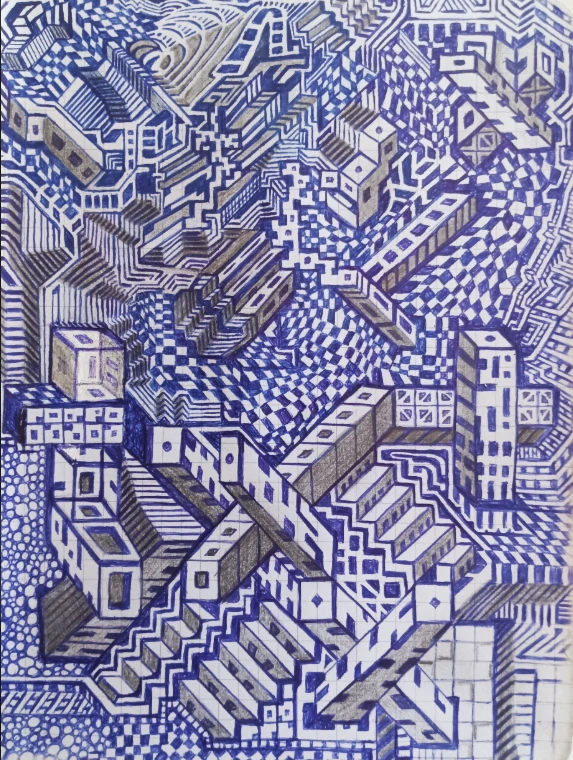
The ARTITOY has become my artistic version of SPACE—an elastic, evolving cosmos of configurations populated by abstract marks and forms. This conception has generated an endless range of visual ideas rooted in symmetries, tessellations, gestalt perception, higher‑dimensional geometries, multi‑angular viewpoints, and non‑Euclidean or topological surfaces. Over the years, I have developed seven drawing‑design styles—my visual engines—each exploring the creative possibilities of the line through oneliners, scribblers, geometricals, doodlers, abstract pointillism, grids, and mixed media. As my practice expanded, I began fusing these engines with devices and three‑dimensional objects, creating new generations of artitoys such as rotationals, bidimensional holograms, non‑Euclideans, texturals, and sculpturals. These generations will continue to be integrated evolving into macro‑structures and immersive systems that invite viewers to explore and manipulate SPACE in participatory ways. I also would like to welcome commissions in which external themes will guide my elaborations through research, as in my mixed‑media collage La memoria de nuestra agua, and mixed-media Wishstructure.

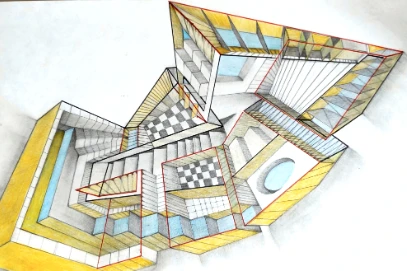
There is a tension between strict structure and open interpretation in your work. How do you balance control and unpredictability?
When I start an ARTITOY, I may proceed in either of two distinct yet connected methods. One is just making some linear marks at random that I moodily choose from my visual engines. If I feel the drawing is flowing and promising, I engage in a visual game of discovery that eventually will be fused to a device. This is a purely intuitive visualizing procedure yet based on my structured vocabulary of seven drawing styles at hand. The other is already bringing to this process an idea of spatial configuration to develop. To discover what emerges becomes a more conscious and planned effort of creation, yet still uncertain. In both cases, the balance lies in the unpredictability of the process in various endpoints by applying my controlled abstract visual language. Another feature of balance is more technical. I use creative algorithms or sets of instructions or rules that I ideate and implement while I progress in the drawing. As it unfolds, it reveals different configurations at different endpoints. In the end, the almost mechanical analog drawing operation becomes an intuitive design that makes possible a visual game, thus fusing the distinct art disciplines of drawing and design, and mimicking the digital through the analog.
Many of your references deal with dimensions beyond what we can see with the naked eye. Are you trying to represent those dimensions or suggest them?
In my created cosmos, I treat space as if it were real, so just a simulacrum. In this realm, I picture SPACE as the result of an explosion of infinite force, borrowing the idea from the Big Bang Theory in physics. As a result of the infinite expansion of space, dimensions are created. SPACE expanding at such a rate does not merely stretch outward, but makes more room for more space to fit. Therefore, a dimension is an extra space to the previous one as it expands. In other words, SPACE expands dimensionally, not extensionally. Space becomes more complex, not necessarily bigger. To have an image of this idea, I treat dimensions as systems of reference for the elements they contain. The images I draw that I claim to be dimensional are perspectives that have no relation to any reality at all. They become closed systems with their own rules, becoming their own reality. Any resemblance between my dimensional images and what we consider real is purely coincidental. And yet, if one day this idea is proven true, I will be glad it was worth making, and if not, it will be the best daydream I have ever had.
See more of Nelson’s work on Instagram, Facebook, or his website.