Newsletter #013: Designer collective ADHD on creating experiences through intuition, technology, and and spatial discovery
"...Ultimately, we try to leave room for multiple possibilities. A work is truly complete only through the presence and responses of its viewers.”
This idea immediately resonated with us. There is a lot of common ground between how ADHD approaches its work and the kinds of questions we explore at LINKLAB: how people experience space, how structure can create possibility, and how intuition can shape the making process. We were excited to learn more about how those ideas come together in their work.
—Sooyoun and William, Co-Founders & Principals
INSIDE
COMMUNITY: ADHD
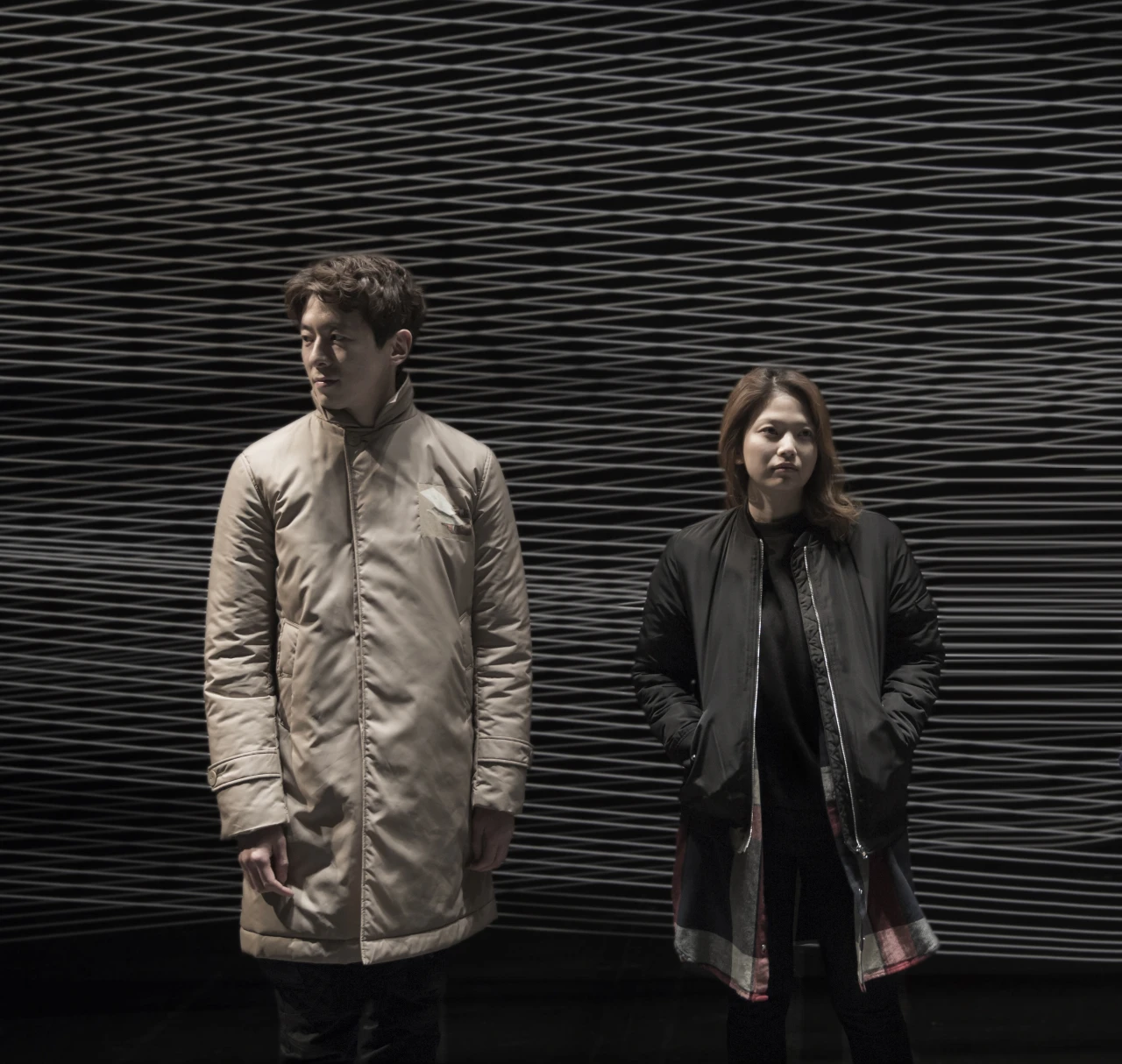
ADHD is an artist and designer collective led by Young Eun Kim and Jiha Kim in Seoul. Their work spans architecture, lighting, kinetic art, media, and music, bringing together physical materials, movement, light, sound, and systems. ADHD creates installations where the viewer becomes part of the work itself, whether that is seeing a work from different perspectives or physically activating it. This month, we spoke to them about why environmental variables are so central to their creative mission.

What draws you toward certain ideas or areas of exploration? How do you things like space, material, culture, history, and identity influence what you choose to pursue?
Rather than remaining within the framework of a particular culture, historical context, or individual identity, we tend to look at materials and spaces from a more detached, neutral, and non-anthropocentric perspective. This naturally leads us toward principles of natural phenomena and mathematical orders that extend beyond specific cultural backgrounds.
This approach reflects the team’s individual dispositions, but it also reflects a desire to create a kind of “universal sensory language”—one through which anyone can communicate intuitively through physical sensation, without requiring prior knowledge or a particular cultural background.
Your project, Process of Death, sparked our awareness of ADHD. In our opinion, the title adds layers or meaning to the art. Did the title come before the creation of the piece or after?
In most cases, the theme and medium of a work become clear before its title, and we tend to choose a title later that best expresses what the work is trying to convey. Process of Death, however, was a little different. From the beginning, we wanted to express the idea of a radiant process of death, and we decided on the title before we began making the piece.
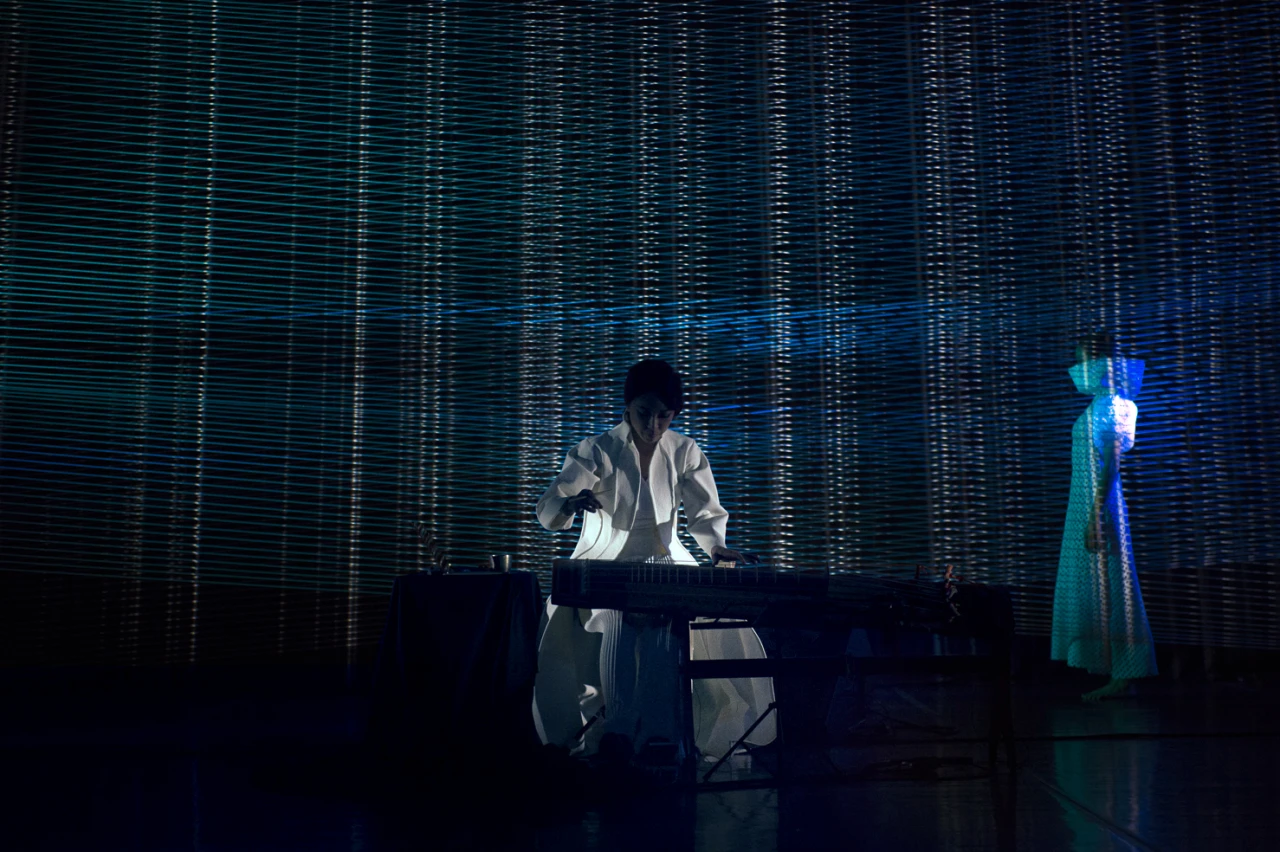
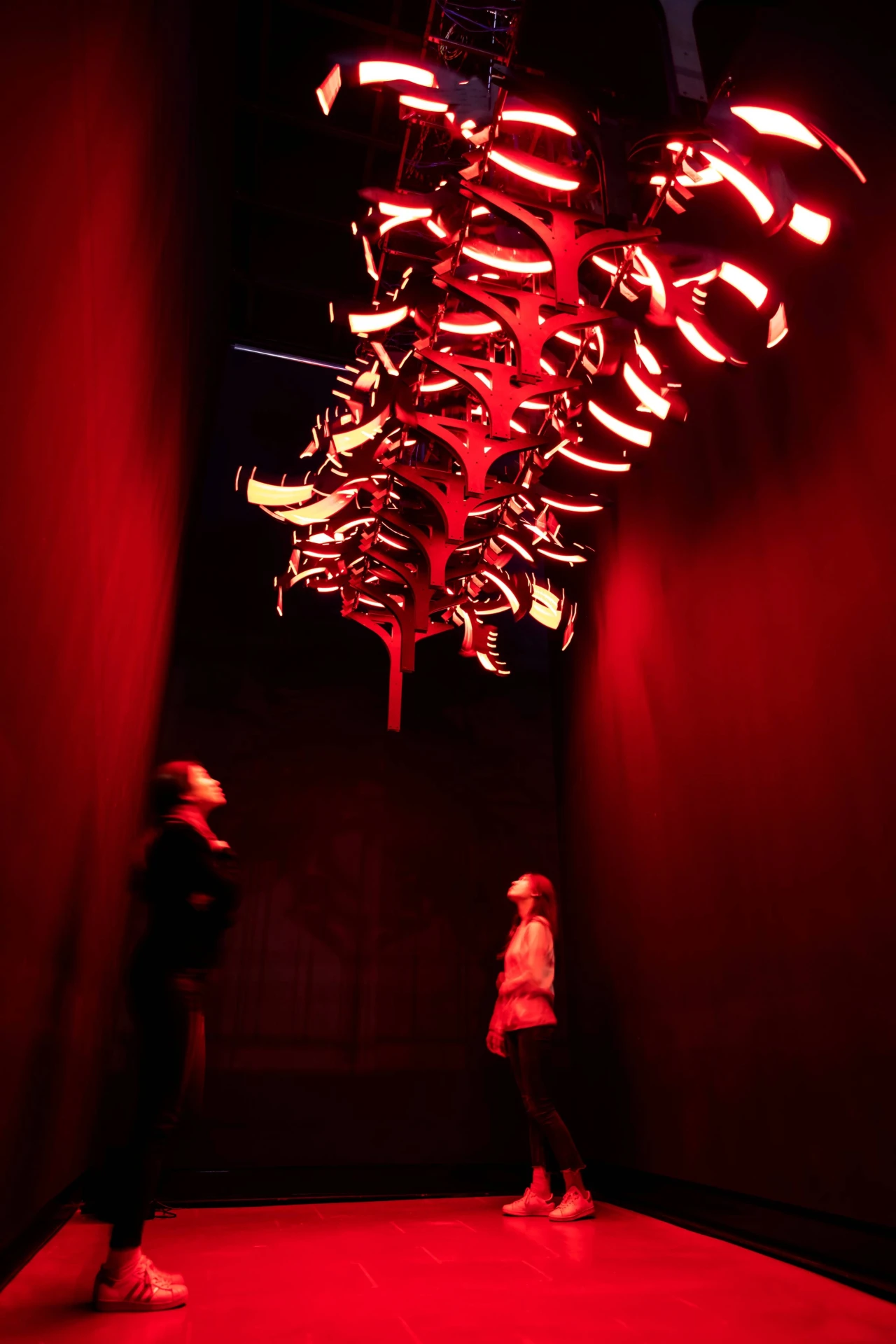
The work is part of Origami Universe, a series of paper-based kinetic installations. The series explores the cyclical processes of life and death through mathematical principles and structures. While Process of Death continues the broader themes, medium, and mechanisms of the series, it carries a more personal and specific meaning.
Before we began making the work, the father of one of our members passed away from cancer. She wanted to create a work in remembrance of his life. We wanted the piece to express the idea that although human life as a whole can be understood as a process that ultimately moves toward death, every moment within that process can nevertheless be filled with radiance.
For this reason, unlike most of our works, we developed the title and its meaning first, and then translated that idea spatially through light, structure, movement, and music. As the structure gradually dissolves along with the music, it evokes a kind of cosmic horror; at the same time, the dazzling radiance emerging from within is intended to allow viewers to encounter the processes of life and death with a positive sense of awe.
Because your team blends backgrounds in architecture, lighting, kinetic art, media, and music, a project could theoretically start from any of these domains. What does your ideation process look like in the very beginning?
The starting point varies from project to project. Sometimes it begins with an image or phenomenon found in nature, and sometimes with a very physical experiment, such as the movement of a particular material or the reflection of light. Music, the exhibition space itself, or a proposal from a collaborator can also become the starting point.
In the early stages, rather than deciding on a fixed image of the finished work, we continuously exchange keywords, images, material samples, simple models, and movement tests. Because we all come from different backgrounds, we can sometimes imagine completely different outcomes from exactly the same idea.
So, when a verbal discussion seems like it will go on for a while, we don’t hesitate to make a quick mock-up and decide on the direction by seeing and testing it. At the same time, it is precisely this process of interpreting an idea from different perspectives—and sometimes clashing over those interpretations—that often opens fresh and unexpected directions we could not have anticipated at the beginning.

Where does intuition fit into your process, especially when you’re working with systems, structure, or data?
Many of our works begin with an intuitive image or sensation, then develop through the process of creating structures and rules that allow that intuition to be realized in physical space.
Rather than directly reproducing an organic movement found in nature, for example, we first identify a rhythm or pattern within that movement that we find compelling. We then translate it into rules through geometric structures, motor movements, algorithms, or changes in light. When unexpected movements emerge during simulation or testing, we return to intuition to decide what to keep, adjust, or develop further. In that sense, our process is a continuous back-and-forth between intuition and structure.

When designing interactive spaces, how much do you try to guide what visitors do, and how much do you leave open to unexpected or unpredictable interactions?
When thinking about the relationship between the viewer and the work within a space, we generally approach it on two levels.
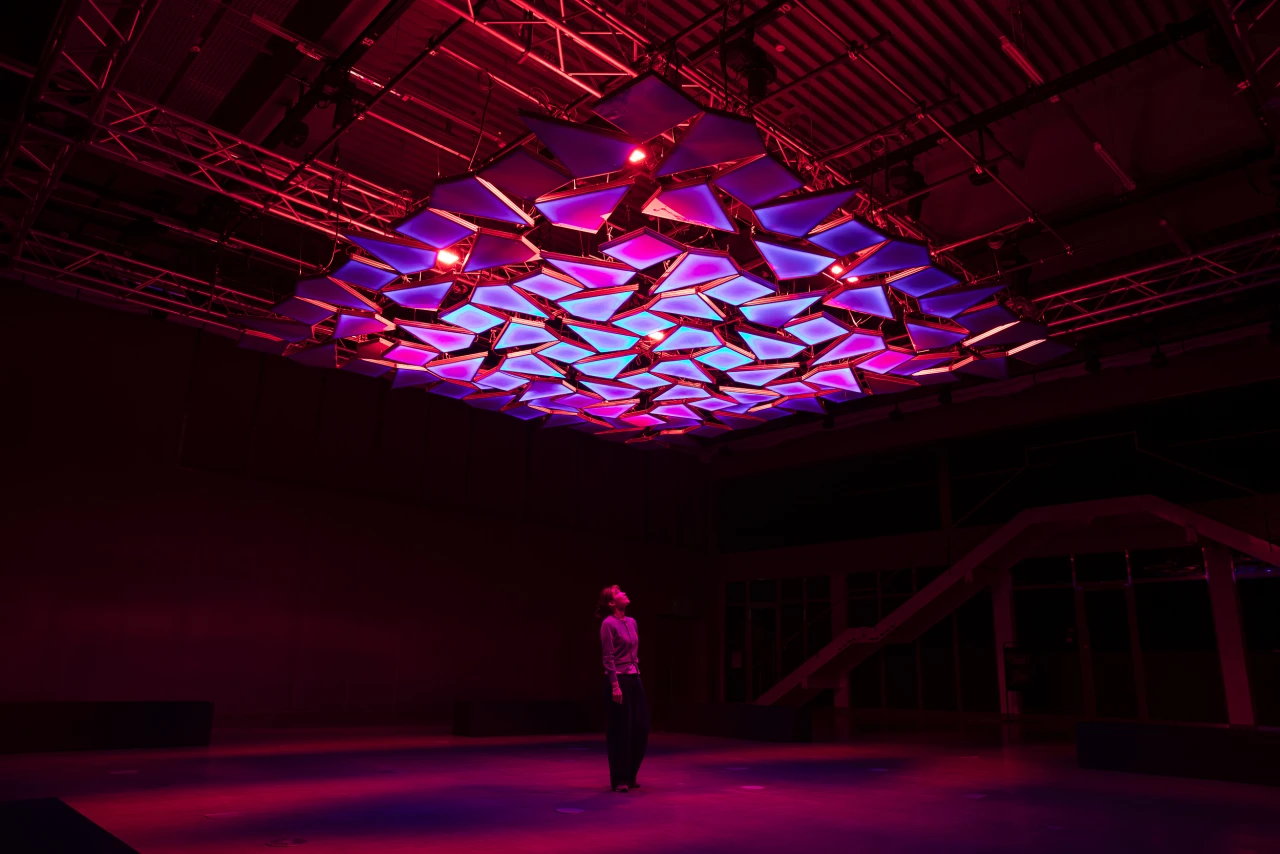
The first is to create a particular atmosphere or sensory condition within the space. Rather than directing every action a visitor takes, we offer subtle cues that might make them want to approach a work, stay with it for a while, or walk around a moving structure to see it from different perspectives.
The second is a more carefully structured approach, in which the narrative of the work is completed through the viewer’s participation. A viewer might physically touch and manipulate a structure to bring about changes, or the work might reveal entirely different forms and movements depending on their path through the space and their point of view. In these cases, the viewer is no longer simply an observer but becomes a key “parameter” that activates the entire system.
Ultimately, the difference lies in how precisely the mechanism is structured; in either case, we try to leave room for multiple possibilities. This comes from our strong belief that a work is truly complete only through the presence and responses of its viewers.

Your installations can involve complex technology, but the response they create can be intuitive, playful, or emotional. How do you keep the technology from overshadowing the human experience?
I don’t think we have ever begun a project by consciously deciding what comes first—technology or human experience. For us, technology is less something we want to present as a strength in itself and more a medium that enables the experiences we imagine. We generally begin by asking what kind of sensation or experience we want to offer the viewer, then look for and integrate the technologies best suited to bringing that experience into physical reality.
We are particularly interested in using familiar materials or technologies in slightly unconventional ways to create unfamiliar sensations. We like it when viewers become curious and think, “How on earth did they make that?” When we exhibited works such as Flower and Process of Death, there was a certain pleasure in watching visitors initially experience the works from the front, then gradually move around to the sides, peering behind them and trying to figure out how they operated.
We do not believe viewers have to fully decipher the technical mechanisms to understand or appreciate the work. At the same time, because of the nature of media art, recognizing how a structure or medium operates can sometimes add an entirely new layer to the experience. We therefore try to leave room for different levels of engagement, from immediate intuitive perception to a more structural exploration of how the work functions.
See more of ADHD’s work on their website.